I've been putting word out via twitter, e-mail and the telephone (yup, still do that sometimes) about a new job I've taken. Starting on April 11, I will be a part of the Delaware Government Information Center, a state agency with a mission of connecting Delaware citizens to government. In practice, that means managing Delaware's web site and helping state agencies use the web and social media to do a better job of communicating with and interacting with the people of the state.
As you may know, this sort of thing is what I really enjoy.
At the same time, a new job means leaving behind the work I've been doing for more than 12 years as GIS Coordinator and Census State Data Center lead for the Delaware Office of State Planning Coordination. This is a time of transition and reflection.
I’ve been around to see the State Planning Office grow into a small, focused, effective service bureau that helps state agencies, local governments, businesses and citizens come together (when that’s possible) on land use planning issues.
I'm very proud of the work done by the Delaware Geographic Data Committee in the time I've been associated with that group. I've made great friends among Delaware's GIS Community and I plan to stay involved, if at a lesser intensity.
I have been honored to be a part of the National States Geographic Information Council, an astonishing group of people from all 50 states, the District of Columbia, and the territories who lead GIS efforts in their part of the nation and come together to improve government at all levels.
And I have had the satisfaction of working with the people of the US Census Bureau to help plan for and carry out the decennial census and to distribute data and information from the Census Bureau to people, businesses, and units of government.
Working within state government can be very rewarding. We take our lumps of course -- sometimes rightfully so -- but at its most basic level, public service means helping people. I do that with data and information and sometimes with some modest expertise. I'll keep doing that sort of work in my new job, I enjoy it.
Showing posts with label internet. Show all posts
Showing posts with label internet. Show all posts
Thursday, March 31, 2011


Saturday, October 9, 2010
This May Be the Most Accurate News Story Ever
I found this via twitter on the NPR web site. I don't expect it to survive there long, so I did a screen-grab and posted it to flickr.
I can't help myself. I love things like this.
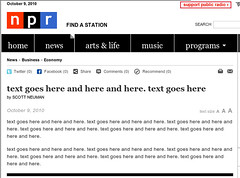
I can't help myself. I love things like this.
Saturday, May 22, 2010
This is Why I Became an Active Internet Citizen
Mother Jones News has a story up about an effort by members of MetaFilter to help two young Russian women who appear to have almost fallen prey to human traffickers: MetaFilter Saved My Pals From Sex Traffickers.
Though I am not very active on the site lately, I've been a MetaFilter member for about six years now and the reaction of this on-line community, and their success in dealing with this story, is no surprise.
I found MetaFilter when I was looking for help on a much more mundane level. A web-search for advice on an automotive matter led me to a MetaFilter discussion that solved my problem and I later joined the site. It was my educational resource for what the web has become, for blogging, on-line photography, and for social media.
I followed this Russian students/sex-traffickers story from afar this week. I had nothing to contribute, but I find this a fascinating example of what we can and should be in on-line communities.
Though I am not very active on the site lately, I've been a MetaFilter member for about six years now and the reaction of this on-line community, and their success in dealing with this story, is no surprise.
I found MetaFilter when I was looking for help on a much more mundane level. A web-search for advice on an automotive matter led me to a MetaFilter discussion that solved my problem and I later joined the site. It was my educational resource for what the web has become, for blogging, on-line photography, and for social media.
I followed this Russian students/sex-traffickers story from afar this week. I had nothing to contribute, but I find this a fascinating example of what we can and should be in on-line communities.
Saturday, March 13, 2010
Here's Something I Think You Should Do

A part of the overall stimulus package is funding to improve Americans' access to the internet via broadband -- to ensure access to rich content, audio, video, and really fast data transfer. To spend that money wisely, the feds need to have a clear picture of where there is strong broadband and where there is not. They need a detailed map of broadband access. They need geospatial data about it.
Think for a moment about the pissing match between ATT and Verizon in those annoying cell-phone commercials. It comes down to dueling versions of maps of "3G" access. Which one is right? Can we really take ATT's word, or Verizon's word? Not really.
That's why we need independent information on what is the true broadband picture. Where is wired access? Where is wireless?
Many of the states (including Delaware, over at DTI) are working on broadband mapping using federal grants to gather data from providers and work with the public. In support of this, the FCC has created, and this week released, a widget that combines collection of "where" information (the geospatial part) with existing broadband speed testers (the data part).
I heard an announcement of the new widget at this week's mid-year conference of the National States Geographic Information Council (NSGIC), in Annapolis. The new Geospatial Information Officer (GIO) at the FCC is the former GIS coordinator of California, Mike Byrne, long a respected NGSIC member. He announced plans for the widget on Monday and sent word on Thursday that it was live.
I've written different versions of this post on the NSGIC blog and on my State of Delaware GIS coordination blog. But this widget isn't just meant for GIS geeks, it's meant for all of us.
So take a minute or two and test your speed. Help the feds use actual data to spend our money wisely.
Sunday, February 28, 2010
Have We Lost Wordle?
If you've read my efforts here, or on the DGDC News blog, or on the NSGIC News blog, you'll know that I am a fan of Wordle, a lovely little web tool that is used to create word clouds from blocks of text. This morning, I read on TechCrunch that Wordle has run into trademark trouble. Someone already owns the name "wordle" and they want it back.
I use Wordle to creat graphics that illustrate points I'm trying to make. For example, here is a word cloud I made from the abstracts for presentations planned at the 2010 Delaware GIS Conference:
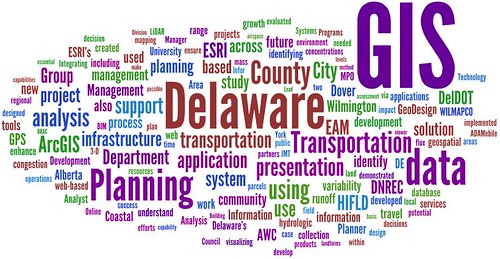 I used this in a series of posts introducing the various presentations. I've also used Wordle-generated word clouds in presentations, in e-mails, and as a representation of my work duties that is posted on my office door.
So, the thought of losing this tool makes me sad. The developer has posted a request for pro-bono legal advice. That's all there is at wordle.net just now. As far as I know, that site was never a money-making proposition.
I hope an accord with the trademark-owner can be reached. Or, at least, that the-site-formerly-known-as-Wordle can come back under a new name.
Update 1: Phil Bradley's comment points to his own post on this (Wordle Closed - alternatives) which includes a list of other word-cloud tools. It's very helpful.
Update 2: Richard James has let me know that Wordle is back, at least for now. And the TechCrunch post has been updated with a link to a twitter campaign to save wordle.
I use Wordle to creat graphics that illustrate points I'm trying to make. For example, here is a word cloud I made from the abstracts for presentations planned at the 2010 Delaware GIS Conference:
So, the thought of losing this tool makes me sad. The developer has posted a request for pro-bono legal advice. That's all there is at wordle.net just now. As far as I know, that site was never a money-making proposition.
I hope an accord with the trademark-owner can be reached. Or, at least, that the-site-formerly-known-as-Wordle can come back under a new name.
Update 1: Phil Bradley's comment points to his own post on this (Wordle Closed - alternatives) which includes a list of other word-cloud tools. It's very helpful.
Update 2: Richard James has let me know that Wordle is back, at least for now. And the TechCrunch post has been updated with a link to a twitter campaign to save wordle.
Wednesday, February 17, 2010
"BBS" Means What, Now?
There's a note on CrunchGear today that takes me back to my earliest web work. Yesterday, apparently, was the birthday of the first-ever public "BBS," which stood for "Bulletin Board System."
A BBS was a dial-in, text-based computer bulletin board; not quite "the web" as we know it now, but a start. That first one started in 1978!
I was not involved in BBS work that far back, but I did run a BBS for Delaware's Department of Natural Resources and Environmental Control back in the early 1990s when I was a Community Relations Officer.
Our intent was simple -- we wanted to provide a place for the regulated community to access the latest versions of the state's environmental regulations. That meant translating all of the regulations into text files -- ascii text files with no formatting.
Of course, many of the regulations in those days dated back to before the widespread use of word-processing systems. In some cases, we were scanning and translating old, several-times copied typescript.
And we were struggling to create a usable system that the few very computerized engineering firms could use. I think we succeeded.
Later in the 1990s, I was working for the Economic Development Office and got to set up a series of World Wide Web pages to present census and other data to small business and other data users. I was using very rudimentary HTML coding and every section of the site was a new design challenge.
Things have changed a lot. Today, almost all state agency web sites use a "common look and feel" web page design put together by the government Information Center. We use twitter and RSS feeds and, in some cases blogging software and other tools.
But if you trace back from today's gov 2.0 web sites, you find simple, text-based BBS systems that were accessed over phone lines using modems that beeped, and booped, and transferred data via some strange wash of white noise.
A BBS was a dial-in, text-based computer bulletin board; not quite "the web" as we know it now, but a start. That first one started in 1978!
I was not involved in BBS work that far back, but I did run a BBS for Delaware's Department of Natural Resources and Environmental Control back in the early 1990s when I was a Community Relations Officer.
Our intent was simple -- we wanted to provide a place for the regulated community to access the latest versions of the state's environmental regulations. That meant translating all of the regulations into text files -- ascii text files with no formatting.
Of course, many of the regulations in those days dated back to before the widespread use of word-processing systems. In some cases, we were scanning and translating old, several-times copied typescript.
And we were struggling to create a usable system that the few very computerized engineering firms could use. I think we succeeded.
Later in the 1990s, I was working for the Economic Development Office and got to set up a series of World Wide Web pages to present census and other data to small business and other data users. I was using very rudimentary HTML coding and every section of the site was a new design challenge.
Things have changed a lot. Today, almost all state agency web sites use a "common look and feel" web page design put together by the government Information Center. We use twitter and RSS feeds and, in some cases blogging software and other tools.
But if you trace back from today's gov 2.0 web sites, you find simple, text-based BBS systems that were accessed over phone lines using modems that beeped, and booped, and transferred data via some strange wash of white noise.
Sunday, December 27, 2009
Changes for a New Year
I took some flak from family members over the holidays for the slow-down in blog posts over the last few months. I have let my on-line energy be soaked up by twitter and facebook, of late. I've decided to try to bring some of that back here. As part of that, I've started moving to a three-column layout. Things may change a bit over the next few days as I settle-in and settle-on a new look.
Sunday, December 6, 2009
Scrapple Flame Wars of 1872
MetaFilter points to an entry from the New York Times of a few days back that reports on an incident of angry letter-writing in the Times in the late 1800s.
"The Way We Ate: The Great Scrapple Correspondence of 1872" recounts a discussion of scrapple, our regional "delicacy," in the Times' letters. It all started with a note from a transplanted Pennsylvanian, who wrote, in part:
The MetaFilter post points to this as an early example of the sort of behavior that is now known as "flaming" on the internet. It's comforting to note that nastiness, cynicism and brutal satire are nothing new; they are, in fact, a part of our national character.
"The Way We Ate: The Great Scrapple Correspondence of 1872" recounts a discussion of scrapple, our regional "delicacy," in the Times' letters. It all started with a note from a transplanted Pennsylvanian, who wrote, in part:
In Pennsylvania there is an article in general use called "scrapple," or "scrappel," which is one of the best substitutes for meat that i know of. On coming to live in New-York I missed it very much, and, as a consequence, it cost us a large amount for mutton-chops, beef-steak, &c. , for breakfast, for which "scrapple" is excellent. My wife then brushed-up her house-keeping and cookery lore, and resolved to make the article herself, which she does to perfection. And the result is, we have a delicious article of diet at a very small cost, which takes the place of meat for the morning meal, and which is, I believe, quite as nutricious, as I know it is more toothsome.This led to the eventual publication of a recipe for scrapple, which was discussed and debated at some length.
The MetaFilter post points to this as an early example of the sort of behavior that is now known as "flaming" on the internet. It's comforting to note that nastiness, cynicism and brutal satire are nothing new; they are, in fact, a part of our national character.
Tuesday, March 17, 2009
Sometimes I Wonder If I Really Understand This Internet Thing
 I took this photo on Sunday evening as I was finishing preparation of our dinner. I had put together a stir-fry of chicken and peppers and zucchini (with as much garlic as I felt I could get away with). I cooked it just lightly in olive oil with a dash of beer. In this photo, it is ready to put over brown rice.
I took the picture because I liked the collection of colors on the stove. I posted it to flickr and pretty much forgot about it.
Until this evening (Tuesday), when I poked my head into my flickr account and found that this little photo has been viewed 149 times in the last two days. That
is an unusually large number of views in such a short time for a picture of mine. More surprising is the fact that all of those views apparently were on Monday.
I've had popular shots before, but usually they are the sorts of things that you would expect to attract attention (the Hooters billboard that fell-over in a high wind, for example).
Why this one? I have no idea.
Sunday, March 15, 2009
"Buckle-up..."
I had a call the other day from a local government PR guy. He had decided to add local bloggers to his news release e-mail list and wanted my e-mail address and my thoughts (I used to be in that business, many years back).
I had the sense that he made the change only grudgingly. Local bloggers, here as elsewhere, enjoy criticizing government and have become something of a source for the public. Rather than ignore them, or fight them, he had decided to offer his employer's point of view directly to them. I think that's a good idea.
But this new relationship won't be the same as that between PR folk and the traditional media. The difference is the activity of reporters. Reporters are trained in researching and questioning what they get from the PR folks. And they bring a cultural proclivity towards balance and objectivity to their work. At least, we hope all these things are true of reporters. Most bloggers tend to come from other traditions and start with a clearly subjective point of view, one that is not usually threatened by much research or questioning. (Yes, I know, there are expectations)
I was reminded of this as I read a fascinating piece by writer and internet-thinker Clay Shirky, Newspapers and Thinking the Unthinkable, which examines the issue of "The Death of Newspapers" that is so much discussed these days (and seems to cry out for capitalization). In it, Shirky explores the idea that we are now (and will be for a while) between the end of one era (ad-supported paper publication of news) and the maturity of another (we have no idea what it will be, but it is starting now).
And he makes this statement, which I think is true:
In fact, for blogging to work well, we depend on reporters to do what Shirky calls "society’s heavy journalistic lifting."
So my friend in government PR should send his news out to the bloggers. It can't hurt and may help spread word on stories deemed too small by the newspapers or TV stations. But he shouldn't -- and won't -- expect bloggers to take-over the role now filled by reporters working for shaky "old media" institutions. We still need them, even if we're not as willing to subsidize their work.
This will make for an interesting period of time as we transition from the old model to a new model that we may not yet be able to imagine.
I had the sense that he made the change only grudgingly. Local bloggers, here as elsewhere, enjoy criticizing government and have become something of a source for the public. Rather than ignore them, or fight them, he had decided to offer his employer's point of view directly to them. I think that's a good idea.
But this new relationship won't be the same as that between PR folk and the traditional media. The difference is the activity of reporters. Reporters are trained in researching and questioning what they get from the PR folks. And they bring a cultural proclivity towards balance and objectivity to their work. At least, we hope all these things are true of reporters. Most bloggers tend to come from other traditions and start with a clearly subjective point of view, one that is not usually threatened by much research or questioning. (Yes, I know, there are expectations)
I was reminded of this as I read a fascinating piece by writer and internet-thinker Clay Shirky, Newspapers and Thinking the Unthinkable, which examines the issue of "The Death of Newspapers" that is so much discussed these days (and seems to cry out for capitalization). In it, Shirky explores the idea that we are now (and will be for a while) between the end of one era (ad-supported paper publication of news) and the maturity of another (we have no idea what it will be, but it is starting now).
And he makes this statement, which I think is true:
Society doesn't need newspapers. What we need is journalism. For a century, the imperatives to strengthen journalism and to strengthen newspapers have been so tightly wound as to be indistinguishable. That’s been a fine accident to have, but when that accident stops, as it is stopping before our eyes, we’re going to need lots of other ways to strengthen journalism instead.There's nothing wrong with bloggers, or the roles that we play. We should criticise and cajole government, industry, and the public, from our own subjective standpoints. We should explore and discuss the world around us. But we cannot, and should not, replace reporters and the work that they do.
In fact, for blogging to work well, we depend on reporters to do what Shirky calls "society’s heavy journalistic lifting."
...from flooding the zone — covering every angle of a huge story — to the daily grind of attending the City Council meeting, just in case.When we bloggers attempt to comment on what we call "the news" through our own direct experience, we run a large risk of getting things wrong -- missing minor details that bring the big picture into focus -- or missing things altogether. But when we have the work of journalists to build on and react to, we can fill a valuable roles as commentators.
So my friend in government PR should send his news out to the bloggers. It can't hurt and may help spread word on stories deemed too small by the newspapers or TV stations. But he shouldn't -- and won't -- expect bloggers to take-over the role now filled by reporters working for shaky "old media" institutions. We still need them, even if we're not as willing to subsidize their work.
This will make for an interesting period of time as we transition from the old model to a new model that we may not yet be able to imagine.
...there is one possible answer to the question “If the old model is broken, what will work in its place?” The answer is: Nothing will work, but everything might. Now is the time for experiments, lots and lots of experiments, each of which will seem as minor at launch as craigslist did, as Wikipedia did, as octavo volumes did.Should be fun.
Saturday, November 8, 2008
An On-Line President
 Barack Obama's candidacy was one of the most web-enabled we've seen and it looks like his transition and presidency will be as well. The transition, for example, will be on line at change.gov.
There are several cool spots on flickr that are focused on our president-to-be. There's a group called "A message for Obama" that invites users to post photographed messages for the President-Elect. I made mine with wordle.
There's also a fascinating set of photos from back-stage with the Obamas, the Bidens, and friends on election night. This photo of Joe Biden greeting Sasha Obama is my favorite.
I think this web-connectedness is part of why I'm so excited about Obama. It's not just that he's using the web the way it can and should be used. It's also the fact that it doesn't seem at all forced; his techie-ness is natural.
Thursday, July 17, 2008
All Politics Is Local?
There's an interesting on-line discussion this week on several sites about a race for a state representative seat in Kansas. Sean Tevis, an IT guy from Olathe, Kansas, is running for the 15th District seat in the Kansas House.
He's a Democrat challenging a several-term incumbent Republican and he's making a strong on-line pitch that includes an xkcd-style infographic about his reasons for running and his fund-raising approach. Told he needs to raise $26,000 for the run and that the traditional approach is to find 52 people to donate $500 each, he has decided to try instead to get 3,000 people to donate at least $8.34 each. And his web site is set up to do just that.
This approach has attracted notice on several web sites nationally, including on metafilter, where Tevis has been a member for many years. He didn't post the link himself, but he has joined in the discussion and seems to be listening to criticism and suggestions from the many commenters. There's a lively discussion which is generating some contributions and is helping Tevis refine his thinking on some issues.
My interest increased when I looked at the District map and realized that Tevis is running to represent the downtown portion of a town that my great-great grandfather helped found, where my grandfather was born, and where I still have some distant cousins.
As of this morning, he's almost half-way to his goal of 3,000 contributors and he's now known to a wider, and growing, group of politically interested voters. Not all of them, however, are local.
He's a Democrat challenging a several-term incumbent Republican and he's making a strong on-line pitch that includes an xkcd-style infographic about his reasons for running and his fund-raising approach. Told he needs to raise $26,000 for the run and that the traditional approach is to find 52 people to donate $500 each, he has decided to try instead to get 3,000 people to donate at least $8.34 each. And his web site is set up to do just that.
This approach has attracted notice on several web sites nationally, including on metafilter, where Tevis has been a member for many years. He didn't post the link himself, but he has joined in the discussion and seems to be listening to criticism and suggestions from the many commenters. There's a lively discussion which is generating some contributions and is helping Tevis refine his thinking on some issues.
My interest increased when I looked at the District map and realized that Tevis is running to represent the downtown portion of a town that my great-great grandfather helped found, where my grandfather was born, and where I still have some distant cousins.
As of this morning, he's almost half-way to his goal of 3,000 contributors and he's now known to a wider, and growing, group of politically interested voters. Not all of them, however, are local.
Sunday, June 29, 2008
Delaware Candidates' Web Sites In Focus
The politics-watching blog Political Realm takes a look this week at the campaign web sites of Delaware Senator Joe Biden and his republican challenger, Christine O'Donnell.
The entry is part of the site's "Web Grades" series, which has been looking at campaign sites since spring of 2007 when they reviewed the sites of the many contenders in the presidential primaries. Interestingly, those reviews, more than a year ago, gave top marks to the web sites of John McCain on the republican side and John Edwards and Barack Obama on the democratic side. Maybe there's something to this internet thing after all?
When I started reading this entry I found myself worried that Ms. O'Donnell, demonstrably younger and therefore potentially more hip than Senator Biden, would take the prize for best campaign web site. But I was pleased to find that the Biden site took the prize with a grade of B to Ms. O'Donnell's D-minus.
Neither site includes a campaign blog, which the Political Realm folks called a disappointment. Both had multimedia content, though Sen. Biden's site was considered stronger and more complete. The Biden site also outshone the O'Donnell site in social-network features.
One might question the objectivity of the Political Realm reviewers; they do not claim to be a non-partisan site. However, despite the fact that I am proudly-partisan myself, I do think they take an even-handed approach to reviewing political web sites. They are reviewing the sites themselves and not the candidates. And the criteria do appear to have more to do with communication and interaction than with policy or position.
The entry is part of the site's "Web Grades" series, which has been looking at campaign sites since spring of 2007 when they reviewed the sites of the many contenders in the presidential primaries. Interestingly, those reviews, more than a year ago, gave top marks to the web sites of John McCain on the republican side and John Edwards and Barack Obama on the democratic side. Maybe there's something to this internet thing after all?
When I started reading this entry I found myself worried that Ms. O'Donnell, demonstrably younger and therefore potentially more hip than Senator Biden, would take the prize for best campaign web site. But I was pleased to find that the Biden site took the prize with a grade of B to Ms. O'Donnell's D-minus.
Neither site includes a campaign blog, which the Political Realm folks called a disappointment. Both had multimedia content, though Sen. Biden's site was considered stronger and more complete. The Biden site also outshone the O'Donnell site in social-network features.
One might question the objectivity of the Political Realm reviewers; they do not claim to be a non-partisan site. However, despite the fact that I am proudly-partisan myself, I do think they take an even-handed approach to reviewing political web sites. They are reviewing the sites themselves and not the candidates. And the criteria do appear to have more to do with communication and interaction than with policy or position.
Saturday, June 14, 2008
Another Word Cloud
 I wanted to try another of these wordle word-clouds. This one is a cloud of the tags I use in del.icio.us. A more practical and clickable version of this has long lived at the lowest left-hand spot on this blog, of course, but I think this gives an accurate picture of what my focus is when I browse the web and mark things for further use.
I search mostly for items of and about Delaware. Many of these I find in my work for state government; I track land-use issues among county and municipal governments. Many of these I mark for inclusion on various pages of my office's web site; we use items relating to land-use planning, about proposals reviewed under the PLUS Process, on the US Census, and about the use and sharing of geospatial data (GIS stuff). I've also used del.icio.us tags to supplement an aggregation of state GIS coordination RSS feeds that I help maintain for the National States Geographic Information Council (NSGIC).
I still want to take another crack at a family-tree wordle. The one I did the other night was just a selection from among the Mahaffies on my tree. I'm trying to figure out a way to extract all 1,700 of the people on my family tree and make a wordle from that last.
Thursday, June 12, 2008
Very Many Mahaffies
 There's a neat light java tool out there called Wordle which creates colorful word-clouds. They are not the sort of thing that you can use for navigation, but they are loads of fun.
 Sunday, May 25, 2008
Among the Many Things I Did Not Know: Why 88888 is So Interesting
Back in November, I posted about rolling 88,888 miles on my Prius. I thought it was just a way-station on my journey of obsessive nerdiness, but that post has had something of a life of its own.
The folks over at Delaware Liberal used it to start a "Guess Mike's Mileage" contest. That was cute. But I've also noticed a steady stream of hits on that post generated by Google Searches for "88888." The most recent, today, was by a web-surfer in Chahārmahāl o Bakhtiyārī, in Iran.
I've noticed that a number of the 88888 searchers are in that part of the world, so I finally got curious enough to follow-up and found two interesting facts about 88888 that may explain why that number is bringing readers.
First, the number 88,888 is a mathematical curiosity:
More recently, 88888 is apparently the account number used by Nick Leeson for the speculative trades that led to the collapse of the UK investment bank Barings in the 1990s.
I just thought it was neat that my car's odometer had 8's straight across.
The folks over at Delaware Liberal used it to start a "Guess Mike's Mileage" contest. That was cute. But I've also noticed a steady stream of hits on that post generated by Google Searches for "88888." The most recent, today, was by a web-surfer in Chahārmahāl o Bakhtiyārī, in Iran.
I've noticed that a number of the 88888 searchers are in that part of the world, so I finally got curious enough to follow-up and found two interesting facts about 88888 that may explain why that number is bringing readers.
First, the number 88,888 is a mathematical curiosity:
888888 is the only five-digit repunit such that the product of itself and all truncations of itself plus and minus one results in twin primes.What? Don't ask me, I just work here. In any case, I've seen 88,888 referred to in several places as a lucky number. These two things are likely related.
More recently, 88888 is apparently the account number used by Nick Leeson for the speculative trades that led to the collapse of the UK investment bank Barings in the 1990s.
I just thought it was neat that my car's odometer had 8's straight across.
Sunday, May 4, 2008
"Getting to Know You....." (Sing with me)
The Cajun has pulled me into another of those games of blog-tag. This one with a "getting to know you theme." I've tagged others, and recently, so fair is fair....
And the questions:
Here are the rules:
- The rules of the game get posted at the beginning.
- Each player answers the questions about themselves.
- At the end of the post, the player then tags 5 people and posts their names, then goes to their blogs and leaves them a comment, letting them know they’ve been tagged and asking them to read your blog.
And the questions:
- What was I doing 10 yrs ago?
I was just starting my current job, trying to coordinate the use and sharing of geospatial data in the state of Delaware as a staffer at the Office of State Planning Coordination (now part of the Office of Management and Budget). - What are 5 things on my to-do list for today (not in any particular order)?
- Empty the dishwasher.
- Play 18 holes of golf.
- Squire my daughter on a visit to her horse, Jazzy.
- Take a nap.
- Convince Karen and the girls to go out for dinner with me.
- Snacks I enjoy:
- Sun chips
- Hummus
- Almonds
- grapes
- Things I would do if I were a billionaire:
- Purchase land that might otherwise be developed in my county.
- Fund scholarships.
- Walk across the US staying at really nice hotels and Bed-and-Breakfasts.
- Play more golf.
- Three of my bad habits:
- Too much snacking
- Too much web-surfing
- Too much talking.
- Five places I have lived: (in no order whatsoever…)
- Bethesda, Maryland
- Waterville, Maine
- Germantown, Maryland
- Rehoboth Beach, Delaware
- Lewes, Delaware
- Five jobs I have had: (in no order whatsoever…)
- Busboy/Dishwasher
- Drugstore clerk
- Radio Announcer
- Public Relations Specialist
- Data Coordinator
- Five bloggers that I wanna know more about:
Subscribe to:
Posts (Atom)