Showing posts with label web. Show all posts

Wednesday, November 30, 2016

Here's a New Website I'm Working On

http://dnrec.alpha.delaware.gov

It's been a while.  But I wanted to pop-in here to post a link to a new website I'm working on: dnrec.alpha.delaware.gov.

This is a new site that will eventually replace the website of the Delaware Department of Natural Resources and Environmental Control (DNREC).

We're starting with an "alpha" site and launching it very quietly; we'll build the new site over time, taking proper time to edit our content and clear outdated content.
So, stop-in, have a look around, and use the "Your Thoughts" link to take our site survey.

Saturday, March 13, 2010

Here's Something I Think You Should Do

Take a moment and go to the FCC's broadband web site and use their broadband testing widget. That will help them build a map of broadband access around the country.

A part of the overall stimulus package is funding to improve Americans' access to the internet via broadband -- to ensure access to rich content, audio, video, and really fast data transfer. To spend that money wisely, the feds need to have a clear picture of where there is strong broadband and where there is not. They need a detailed map of broadband access. They need geospatial data about it.

Think for a moment about the pissing match between ATT and Verizon in those annoying cell-phone commercials. It comes down to dueling versions of maps of  "3G" access. Which one is right? Can we really take ATT's word, or Verizon's word? Not really.

That's why we need independent information on what is the true broadband picture. Where is wired access? Where is wireless?

Many of the states (including Delaware, over at DTI) are working on broadband mapping using federal grants to gather data from providers and work with the public. In support of this, the FCC has created, and this week released, a widget that combines collection of "where" information (the geospatial part) with existing broadband speed testers (the data part).

I heard an announcement of the new widget at this week's mid-year conference of the National States Geographic Information Council (NSGIC), in Annapolis. The new Geospatial Information Officer (GIO) at the FCC is the former GIS coordinator of California, Mike Byrne, long a respected NGSIC member. He announced plans for the widget on Monday and sent word on Thursday that it was live.

I've written different versions of this post on the NSGIC blog and on my State of Delaware GIS coordination blog. But this widget isn't just meant for GIS geeks, it's meant for all of us.

So take a minute or two and test your speed. Help the feds use actual data to spend our money wisely.

Wednesday, February 17, 2010

"BBS" Means What, Now?

There's a note on CrunchGear today that takes me back to my earliest web work. Yesterday, apparently, was the birthday of the first-ever public "BBS," which stood for "Bulletin Board System."

A BBS was a dial-in, text-based computer bulletin board; not quite "the web" as we know it now, but a start. That first one started in 1978!

I was not involved in BBS work that far back, but I did run a BBS for Delaware's Department of Natural Resources and Environmental Control back in the early 1990s when I was a Community Relations Officer.

Our intent was simple -- we wanted to provide a place for the regulated community to access the latest versions of the state's environmental regulations. That meant translating all of the regulations into text files -- ascii text files with no formatting.

Of course, many of the regulations in those days dated back to before the widespread use of word-processing systems. In some cases, we were scanning and translating old, several-times copied typescript.

And we were struggling to create a usable system that the few very computerized engineering firms could use. I think we succeeded.

Later in the 1990s, I was working for the Economic Development Office and got to set up a series of World Wide Web pages to present census and other data to small business and other data users. I was using very rudimentary HTML coding and every section of the site was a new design challenge.

Things have changed a lot. Today, almost all state agency web sites use a "common look and feel" web page design put together by the government Information Center. We use twitter and RSS feeds and, in some cases blogging software and other tools.

But if you trace back from today's gov 2.0 web sites, you find simple, text-based BBS systems that were accessed over phone lines using modems that beeped, and booped, and transferred data via some strange wash of white noise.

Wednesday, December 24, 2008

Convergence: Puppies and Kitties

The first thing to say is that one reads these messages from bottom to top. This is a screen capture from Twitter today; a look at a moment of tweeting by two of the people I follow. They are not talking to each other; they are both entering messages and I happen to be listening to both of them.

dacagle is a cartoonist with MSNBC. thatselbert is a blogger from southwest Sussex County here in Delaware. dcagle was posting some cartoons that involved puppies and kittens and was tracking reader reactions. That led him to declare a theorem about the web: people love kitties and puppies and the web delivers. And, right on cue, thatselbert delivered a cute kitty picture.

I love the Internet.

Monday, December 1, 2008

I Am a Huge Geek #25

Fuelly

I have added a smaller version of the Feully "signature" banner (above) to the left-hand column of the blog. Fuelly is a social-media site designed to allow users to track their fuel economy over time, share that information, and trade fuel-saving ideas.

I've added every fill-up of my Scion to a Fuelly profile since I started driving it in July. Over 18 fill-ups, I'm averaging 32.5 miles per gallon. My best performance has been almost 36 mpg, back in the summer. I go about 300 miles between fill-ups.

As noted above, I am a huge geek.

Saturday, November 8, 2008

An On-Line President

Barack Obama's candidacy was one of the most web-enabled we've seen and it looks like his transition and presidency will be as well. The transition, for example, will be on line at change.gov.

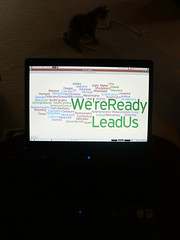
There are several cool spots on flickr that are focused on our president-to-be. There's a group called "A message for Obama" that invites users to post photographed messages for the President-Elect. I made mine with wordle.

There's also a fascinating set of photos from back-stage with the Obamas, the Bidens, and friends on election night. This photo of Joe Biden greeting Sasha Obama is my favorite.

I think this web-connectedness is part of why I'm so excited about Obama. It's not just that he's using the web the way it can and should be used. It's also the fact that it doesn't seem at all forced; his techie-ness is natural.

Tuesday, August 26, 2008

Trying Something New

I'm now an ubuntu user. My old laptop was on its last legs; it was overheating and slow and ready to quit forever. I wanted a new machine and I decided to take a step in a new direction.

Ubuntu is an open-source, community developed, linux-based operating system. It is an outgrowth of the Open Source movement which suggests that the community as a whole can build itself some of the tools that we have had to buy from others in the past.

I bought a modest little compaq laptop that came with windows vista. I dutifully, and patiently, made back-up discs for that operating system. Then I downloaded ubuntu and replaced vista with ubuntu. It felt liberating.

I owe thanks, by the way, to my friend and colleague Charles Wilmire who has shared advice and experience and some hands-on tinker-time to help me take this step.

Now I am working through configuration and settings based on my preferences and my needs. I don't want anything on here that I am not going to need to do what it is that I want to do.

This should be fun.

Tuesday, July 15, 2008

I have Succumbed

When we rolled-over our family of cell-phones this summer, Karen and I decided to get unlimited texting. Colleen, being a teen, seems to have lost the ability to talk on a telephone and communicates entirely by SMS text message. So it made sense for us to become texters ourselves.

Even though we are old.

As a result, I have decided to finally look into twitter. I never thought twitter would be a format that worked for me as a browser-based writer. Twitter is designed to allow users to send short-form updates -- "tweets" -- limited to 160 characters. I have never been "short form."

Still, I don't like to post on Mike's Musings from my machine at work. Sometimes I think of things I'd like to post during the day, but don't feel that I should. So I have signed up for twitter and added a "Random Thoughts" box at left that I can populate from my phone.

God forbid you should ever have to be without my, um, thinking.

Sunday, June 29, 2008

Delaware Candidates' Web Sites In Focus

The politics-watching blog Political Realm takes a look this week at the campaign web sites of Delaware Senator Joe Biden and his republican challenger, Christine O'Donnell.

The entry is part of the site's "Web Grades" series, which has been looking at campaign sites since spring of 2007 when they reviewed the sites of the many contenders in the presidential primaries. Interestingly, those reviews, more than a year ago, gave top marks to the web sites of John McCain on the republican side and John Edwards and Barack Obama on the democratic side. Maybe there's something to this internet thing after all?

When I started reading this entry I found myself worried that Ms. O'Donnell, demonstrably younger and therefore potentially more hip than Senator Biden, would take the prize for best campaign web site. But I was pleased to find that the Biden site took the prize with a grade of B to Ms. O'Donnell's D-minus.

Neither site includes a campaign blog, which the Political Realm folks called a disappointment. Both had multimedia content, though Sen. Biden's site was considered stronger and more complete. The Biden site also outshone the O'Donnell site in social-network features.

One might question the objectivity of the Political Realm reviewers; they do not claim to be a non-partisan site. However, despite the fact that I am proudly-partisan myself, I do think they take an even-handed approach to reviewing political web sites. They are reviewing the sites themselves and not the candidates. And the criteria do appear to have more to do with communication and interaction than with policy or position.

Thursday, January 17, 2008

We're All In This Thing Together

There has been an interesting convergence of on-line collaboration this week that I think highlights the value of sharing our stuff out on the net. The internet provides a space in which a ridiculously large number of people can share, comment on, and react to a wide variety of ideas and works of art. And I think that is a good thing.

Here are a few examples, from my limited web-cruising, and from just this week.

Flickr has announced the formation of a Commons, in which they hope to facilitate a community-wide collective tagging and adding of attributes to publicly available photo collections. It has grown out of the ability of flickr users to add descriptive tags to other users' photos.
All that work that we've put in has contributed to making something greater than the sum of its parts: an organic information system, derived of descriptive words and phrases made entirely from individual contributions.
The Library of Congress has stepped up to the plate to help get things moving by posting about 3,000 photos from their archives and inviting users to add tags, descriptions, and further information. The project gives another window into the rich photographic history of the nation, and may just add a deep new understanding of the material in those collections.

From the Library’s perspective, this pilot project is a statement about the power of the Web and user communities to help people better acquire information, knowledge and—most importantly—wisdom. One of our goals, frankly, is to learn as much as we can about that power simply through the process of making constructive use of it.

The old-photos blog Shorpy (a favorite of mine) provides some moderately ironic proof of concept. Shorpy takes selected photographs from the Library of Congress' older site, which has traditionally offered thumbnail views and possible click-thrus to raw images, and prepares them for on-line viewing. In a sense, it has been a precursor to the new Library of Congress effort with flickr; it colleted information via blog-style commenting.

Yesterday, the same day as the flickr/Library of Congress announcement, Shorpy posted a photograph of the Drake Family, and father and two sons musical group, playing at a dance in Texas in 1942. The posting was spotted and commented-on by two daughters and a grand-daughter of the young men shown playing music so long ago. They added fascinating and personal details about the photo.

Meanwhile, in my professional life, I came across an announcement by the real-estate map service Zillow that they have released GIS data of the neighborhood boundaries that they use in their maps. Their intent, they said, was "to allow people to use and contribute to our growing database" by inviting users to add new neighborhoods, or suggest edits to those already in the collection. And users can post their work back to Zillow for eventual integration into Zillow's on-line offerings.

This is a form of on-line collaborative work that requires a bit more specialized software, but it follows the same pattern as the Flickr/Library of Congress and Shorpy models -- the collective knowledge and group energy of a web-full of regular folks can add a remarkable amount of knowledge to our culture.

Sunday, August 26, 2007

Random Images, and Music

Here's a neat art project: a randomized music video that draws imagery from the whole of flickr.

The fellow who created ASTRONAUT -- Felix Jung -- has taken a music track by a friend and used keywords based on the lyrics to fetch semi-random images from flickr, based on tags given to those images. He has built a web-movie, using Flash, that incorporates those images into a simple music video of the song.

Flickr users can add tags to their images as a way to organize them or categorize them. For example, I have quite a few photos tagged with "Vermont." There are even more tagged "Vermont" by other users. Using tags, I can quickly see all of my Vermont photos or look at photos of Vermont from other users.

Felix Jung has taken this a step further, as he explains in his post about this project:
Each time the Flash file is loaded, new images are randomly pulled from Flickr. I've hard-coded 53 keywords at set points in the song, and when the page is first loaded... calls are made out to Flickr to retrieve these keywords. With each call, I vary the parameters a little bit.
The song includes either the word or the concept "distant" towards its end. Jung has taken that as a keyword and called flickr photos tagged with "distant." There are 4,664 photos so-tagged as I write this morning. The parameters Jung refers to are changing ways to randomly sort and select from the found images. That way, different images are chosen each time the movie is played. This morning, my playing of it turned up this image.

It's a simple thing, but makes nice use of the many images that flickr users are adding to the public face of flickr each day.

We sometimes forget about the potential for the web to be a global, interactive, collaborative marketplace of ideas. We add content -- through blogging or posting photos, sound or video -- partly to satisfy our egos and be "published." But we also should remember that we are adding small bits to something larger that grows in ways we cannot forsee.

This is what is at the heart of the philosophy of the Creative Commons.

At least part of our pleasure in this Internet thing should be to see to what unexpected use other folks put our creations.

Saturday, June 30, 2007

So, You Want One of Them iPhone Thingies?

I don't know if you noticed, but there was a frenzy yesterday. A frenzy over a new product.

Folks from all around the nation lined up, camped out, waited sometimes patiently for a chance to spend a good deal of money on a shiny new tech-toy.

Was it worth it? Time will tell.

I do understand the desire for an iPhone. It's smaller. Faster. Shinier. Packs lots of other products into little space.

But do we really need it? We already have tools that serve the functions found in the iPhone. We just don't have them all in one small place.

The iPhone may be like the iPod. Eventually, we may all have one. But I think I will wait for a bit. I don't need to spend that much money for functionality that I already have. And I'm put off by the fact that the iPhone only works with ATT; their monthly plans for the use of the thing seem pretty steep.

I can wait.

Monday, May 28, 2007

Half a Century Later...

The first digital image was created 50 years ago this spring at the National Bureau of Standards (now known as the National Institute of Standards and Technology, or NIST). It was a very small scanned photo of researcher Russell Kirsch's 3-month-old son Walden.

That was the first step in a journey that has led to on-line photo-sharing sites like flickr and to high-resolution aerial photography and to citizen journalism and an on-line explosion in the arts.

Of course, it also led to pervasive digital pornography and photo-shopped political frame-jobs.

But you take the good with the bad.

Saturday, May 19, 2007

I Doubt This Will Surprise Those Who Know Me...

...But it appears that I am an "Information Technology Omnivore," according to an on-line tech-use survey from the Pew Internet and American Life Project.

The survey is part of a Pew study, A Typology of Information and Communication Technology Users, which attempts to describe the many different ways that we use our suite of information technology tools. According to the Pew study, "85% of American adults use the Internet or cell phones – and most use both." On the other hand, about half of Americans "have a more distant or non-existent relationship to modern information technology."

In other words, many have the tools and many use them, but only a small percentage are really comfortable in an on-line world.

It looks like I am one of this group, about 8% of the American public. The Omnivorous Tech Users are described as embracing the connectivity provided by technology to enhance their work lives and personal lives:
Members of this group use their extensive suite of technology tools to do an enormous range of things online, on the go, and with their cell phones. Omnivores are highly engaged with video online and digital content. Between blogging, maintaining their Web pages, remixing digital content, or posting their creations to their websites, they are creative participants in cyberspace.
I don't exhibit all of the characteristics of this group. I don't create video content very much and I don't IM or text message beyond what is required to keep tabs on a teen-age child. And I am well outside one of the key demographic characteristics: "The median age is 28; just more than half of them are under age 30."

I do feel old some days.

Ironically, two co-workers and I explored this same territory in a slightly different way yesterday. We had all heard keynote speaker Don Cooke talking about Second Life at the recent Delaware GIS Conference. That led to a discussion of on-line communities and some of the skills needed to maintain and grow them. I've been thinking about this a fair amount lately, in relation to my work with Delaware's GIS Community, and the National GIS Coordinators group (NSGIC) both of which are partly on-line.

Dave wondered aloud which world, the physical or the on-line, was, in fact, reality. We briefly considered the theory proposed in the film The Matrix (the first one), that what we perceive as reality is in fact a simulated, virtual reality dream world constructed and maintained to keep the entire human population in a state of subjugated sleep.

We skipped the obvious contemporary political implications of this thought and turned briefly to Plato's allegory of the cave in which what humans perceive as reality is in fact only the shadows of a puppet show cast on the wall of a cave in which they are prisoners (/oversimplification of complex philosophical thought).

At that point we realized that once you've pursued a thought back to Plato's cave, it's probably time to move on to something else.

As I write this blog entry, it occurs to me that one could rewrite Plato's allegory in modern terms with the Internet as the cave and blogs and web 2.0 things creating the shadows.

But there is a sunny Saturday morning outside and the grass needs to be cut. The library needs to be walked to. The state park is hosting a kayak expo.

I may be an Information Technology Omnivore, but I know when it is time to shut down the laptop and head outside.

Friday, May 11, 2007

Sometimes I Like to Join the Crowd

Originally uploaded by murf_90I joined in a worldwide "all take a photo at the same time" event today.

The project, ShutterClock, was the brainchild of Ronan Murphy, who is finishing his college career (I think somewhere in the UK).

That's Ronan on the left there, in his entry into his own project, which he describes fairly simply:
We want people to come together as a simple community divided only by distance to globally capture their world at an organised time. In return we will see galleries of images from all over the world, taken at the same moment but from their point of view.
I learned about this idea from the flickr blog this morning. It sounded like fun. All I really had to do was keep my camera by me at the end of the afternoon and keep an eye on the clock. The project was set for people to take their photos at 8:00 p.m. GMT (4:00 p.m. Eastern Daylight Time).

As it turned out, my photo was of a prosaic "afternoon in the office" sort of moment.

Almost the End of the Work Day

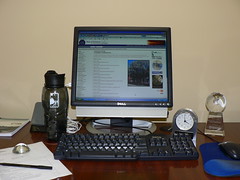
That's my keyboard and screen, with the agenda for a meeting I'm hosting on Monday morning on the left.

I uploaded my photo to the ShutterClock group at flickr. Some folks sent pictures directly to the ShutterClock site, where there are a selection of the photos. There was even a phone number to facilitate submission directly from camera phones.

Sometimes it's fun to be a small part of something larger.

Sunday, January 21, 2007

Have You Noticed All The Hype About "Second Life?"

This guy has. He's created Get a First Life to mock the hugely successful Second Life, in which players lead a whole new "virtual life."

It's just comedy, but I think it serves as a gentle reminder that we do have a life in the real world, and we do need to pay attention to it.

MOT

I've expressed my appreciation of Delaware's growing blogosphere, and I stand by that appreciation. But I also think we should remember to play active roles in our actual lives -- the Delaware-osphere -- as well.

Friday, December 15, 2006

Could This Be Blogging's "Shark"?

There's a story on Federal Computer Week today about a new utility to allow Congress-people to create blogs. The story, House makes blogging easy, is about a new centralized "House Web Log Utility" that let's Congressional offices create and manage blogs on their official Web sites.

I was tempted to make jokes. In fact, I gave-in and used one in the title of this post. But the more I think about it, the more I like the idea.

I like the notion of making it easier for elected officials and, by extension, government agencies, to adopt the blogging ethos of constantly adding information to the web.

Government web sites get stale. Agencies are parts of hierarchies. They have chains of command. Everything has to go through that chain. Web sites are usually maintained by IT staff, or by PR folks, rather than by the people who make decisions and work with constituents.

It would be great to enable those people to add regular and frequent content and updates to web pages. Maybe this will work?

I'm staying positive.