Sunday, December 13, 2009

Furthur, On Up The Road

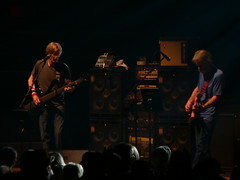
I went up to Asbury Park yesterday to see Furthur, the new band put together by Bob Weir and Phil Lesh, of the Grateful Dead. My golf-buddy Andy came along for the ride. He's not a deadhead, but is not unaware of the music and was open to a new adventure. We had good seats and were well-placed for photography. I had fun with my camera.

The key to this band is the addition of guitarist John Kadlecik, until recently the "Jerry" specialist in the highly-regarded Dark Star Orchestra. Kadlecik plays and sings enough like Jerry Garcia to bring Phil's bass and Bobby's wonderfully complex rhythm guitar into a focus that dead fans will instantly recognize. But he does not come off as a Garcia imitator. That's a good thing.

The setlist is evidence of Kadlecik's influence. I don't think I've ever heard The Golden Road to Unlimited Devotion played live, but it was part of last night's show as was Viola Lee Blues. Both were outstanding.

The sound in the Asbury Park Convention Hall was pretty terrible. It's really just a concrete box and probably better-suited to the pro-wrestling and roller-derby that the beer-selling lady told me are common events there. The sound was muddy and the vocals, particularly Bob Weir's, were hard to pick up. In Bobby's case, I think there was a microphone problem.

The short video below (a bit of Althea) will give you some idea of the sound. Though, in fairness, this was taken with my digital camera.


I bought the insta-CD of the show (soundboard?) and listened to some of it today. The sound on that recording is very good (though the Bobby mic is low). There's a version (audience recording?) on the bt.etree archive of the show (thanks to @nemski for the tip). For deadheads wondering what is possible, post-Jerry, this is worth a listen.

Sunday, December 6, 2009

Scrapple Flame Wars of 1872

MetaFilter points to an entry from the New York Times of a few days back that reports on an incident of angry letter-writing in the Times in the late 1800s.

"The Way We Ate: The Great Scrapple Correspondence of 1872" recounts a discussion of scrapple, our regional "delicacy," in the Times' letters. It all started with a note from a transplanted Pennsylvanian, who wrote, in part:
In Pennsylvania there is an article in general use called "scrapple," or "scrappel," which is one of the best substitutes for meat that i know of. On coming to live in New-York I missed it very much, and, as a consequence, it cost us a large amount for mutton-chops, beef-steak, &c. , for breakfast, for which "scrapple" is excellent. My wife then brushed-up her house-keeping and cookery lore, and resolved to make the article herself, which she does to perfection. And the result is, we have a delicious article of diet at a very small cost, which takes the place of meat for the morning meal, and which is, I believe, quite as nutricious, as I know it is more toothsome.
This led to the eventual publication of a recipe for scrapple, which was discussed and debated at some length.

The MetaFilter post points to this as an early example of the sort of behavior that is now known as "flaming" on the internet. It's comforting to note that nastiness, cynicism and brutal satire are nothing new; they are, in fact, a part of our national character.

Monday, November 30, 2009

I Like This

I'd like to express my support here for the 2010 California Marriage Protection Act, which would ban divorce. It's a reaction to Proposition 8, which "protected" marriage from the evils of expanding marriage opportunities.


One of the many things that pisses me off about the opposition to gay marriage is the hypocrisy of the "protect marriage" crowd. This anti-divorce satire is a fine example of "strategic derision."

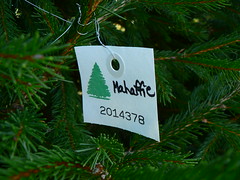
We Tagged A Tree


we tagged a tree
Originally uploaded by mmahaffie
On Saturday, we made our annual trip to the tree farm to tag a Christmas tree. We broke a long-standing tradition, though, by finding the right tree for all four of us almost instantly. Usually, tree-tagging involves a drawn-out series of suggested trees that, for one reason or another, are not approved by the whole committee.

Not this year, this year, we had only a few candidates, all of which all of us liked. Until we found this one, tagged it, paid for it, and went off for a pleasant lunch.

Friday, November 20, 2009

Such a Busy Week

This week has been Geography Awareness Week and Wednesday was GIS Day. It was a busy week for me, in my role as GIS Coordinator for Delaware.

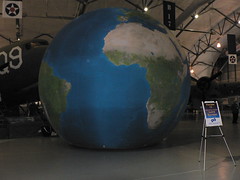
On Wednesday, I volunteered as part of a large group of GIS professionals working with groups of fifth-grade students attending a geography field day at the Air Mobility Command Museum at Dover Air Force Base.

A real hit was a new event for this year; a Geography Game Show presented by visiting artist Neal Nichols, Jr. He drew a large wall-map of the United States, by hand, used it as a fun teaching tool.

I took lots of photos of the kids, and had time to get some shots of the museum as well.

On Thursday, I spent the day at the University of Delaware for a Geospatial Research Day event in which there was a selection of presentations on research, using GIS and geospatial data, throughout the University. I took notes using twitter and turned those into the word cloud posted here.

I also wrote these events up for the DGDC News blog, which is a new blog I've been writing as a communications tool for the Delaware Geographic Data Committee. Between that and the NSGIC News blog that I try to keep up with for the national GIS coordination group, I've had less energy to write here.

It's been a busy, busy week. But fun. And interesting. And fulfilling.

Tuesday, November 17, 2009

Why I Like John Mayer, Reason #287

Here's a series of tweets from musician John Mayer, who is on tour just now and playing the Beacon Theater in New York city tonight:
First: Anybody outside the Beacon looking for tickets?
A few moments later: Ask the man in the ascot if he has a smoke.

Then, eventually:
We have a winner of the two tickets. Lest anybody ask some other man in an ascot for a smoke.
That's pretty cool.

And, there's the completely killer version of Crossroads that he does on his new album, Battle Studies, that Karen turned me on to this evening.

Saturday, November 14, 2009

It was a Dark and Stormy Night, Day, Night, Day, Night...

We're just emerging from three days or so of nasty, wet weather. The remnants of Hurricane/Topical Storm Ida arrived Wednesday night and combined with a bit of a nor'easter to kick the crap out of the shoreline for a few days.

Thursday was a mess, with high winds and steady rains. Both lasted well into Thursday night.

That afternoon, we pulled up the web-video from the DelDOT traffic camera looking on the approaches to the Indian River Inlet bridge. You could see waves washing across a flat where a dune used to stand and onto the highway. Route 1 between Bethany and Dewey has been closed since.

By bedtime Thursday, both of our daughters' school had called to say there'd be no school on Friday. It blew and rained for most of Friday as well. This morning, Saturday, the wind was finally gone and the rain had faded to a day-long, gray mist.

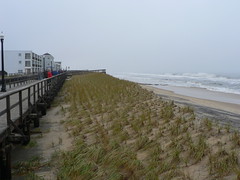
This afternoon I took a drive around the bays and back north to check on my parents' beach house in North Bethany. It weathered the storm admirably. The beach was gone, however.


I took a short video to show what the beach looks like now. This is from the beach crossover at Bethany Village. There's about a four foot drop down to the "beach" and the waves are washing up almost to that sand face. At high tide, it looks like they lap against the remains of the dune.

The dune, which was fairly new, worked well and protected the houses as it was designed. The new dunes in Bethany proper also served well. There had been complains about these dunes, that they blocked the view from the boardwalk.

I think folks are now realizing that the fact that there is still a boardwalk is due at least in part to this new dune.

Sunday, November 8, 2009

Blast from the Past

My friend Barney Krucoff knocked me back into the past a bit this weekend when he e-mailed me a link to a photo of the two of us back in the mid 1970s. This is from a reunion site for Camp Waredaca, where I was a camper from about the age of 8 through 14, which is I think the age I am here. I'm guessing this is from the summer of 1976.

That's me on the far left, with Barney in the middle. On the far right is Mark Binder, now a writer and storyteller in Rhode Island. I remember Mark more as a friend from high school than as a summer camp friend. We're still connected via Facebook and got together for Dogfish beers this summer in Rehoboth.

Barney Krucoff is now the GIS Coordinator for the District of Columbia. He is a member of the Board of Directors of the National States Geographic Information Council (NSGIC) which is where we got to know each other as adults. We'd already made the Waredaca connection. He tells me that one of his kids found this while Googling the family name.

The Waredaca reunion site led me to a Shutterfly set of Waredaca pictures in which I spent at least an hour this morning, wading through the past.

There were no other pictures of me, but there were shots of kids I half-remember from my childhood. There was the pond we swam in, the cabins and tents we lived in, and the morning flag-raising ceremony that started the camp day.

I spotted guys I vaguely remembered hanging out with, and girls on whom I'm certain I had crushes.

And that one cowboy-ish counselor who used to always say, "We've got it to do, so let's do it, to it."

Tuesday, November 3, 2009

Delaware in the Lead Again

I was pleased to hear Delaware's Elections Commissioner, Elaine Manlove, on NPR's all Things Considered this evening. She was part of a story on efforts to improve voter registration, nation-wide.

In Delaware, a new system suggests one possible way forward. At the Delaware Department of Motor Vehicles, the system registers voters almost automatically when residents apply for new driver's licenses or update their old ones.

NPR describes Delaware's approach as "pretty much on the cutting edge." Ms. Manlove, who is a very nice lady, by the way, is recorded trying out the system.
"And it's done — it's on its way to elections," Manlove says. "And then the elections office in Sussex is getting this as we speak, and they can process it."
That's pretty cool. Of course, it does depend on people being in the DMV to register. Meanwhile, the DMV folks are doing a better job of making it possible to not be at the DMV every year. Which is nice.

The NPR story goes on to talk about proposals that the government take more of an initiative in registering voters instead of depending on voters to register themselves.

That may generate some opposition from those who distrust government automatically. But at least people are thinking about improving the system. It's a start.

Sunday, November 1, 2009

Urban Planning, Parks and Their Impacts on Planned and Un-Planned Pedestrian Peregrination

I try to walk, when I can, for exercise and as a way to get out and photograph things. I live in one of the most beautiful, historic, small towns on the east coast -- Lewes -- and work in one of the more picturesque, historic, state capitols -- Dover. Both are in Delaware, for those of you in other places.

A challenge I have, though, is familiarity. In nearly five years as a photo-hobbyist, I have walked and photographed almost all of Lewes (586 photos, so far) and Dover (737 photos). Those totals, by the way, are only those I deemed worthy of uploading to flickr.

So I am happy to report that a change in Lewes' layout has helped me change the way I look at, and photograph, the town. Lewes has recently completed and opened the Canalfront Park, the redevelopment of a rusty boatyard and adjacent state boat launching ramp into a very nice park.

This has given me new things to photograph. And it has changed the way I walk through town.

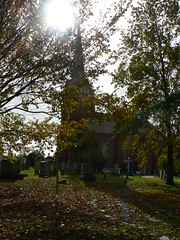
It used to be the case that when I walked into town I would walk down Second Street (our main commercial street) from Savannah Road towards the Historic Society Complex to the northwest. And so I came upon, and often photographed, St. Peter's church from its northeast corner, as at left.

Now, however, I find that I walk up to the Canal, first, wind my way through the park, and circle around to walk back up Second Street from Historic Society Complex. So I now approach, and photograph, the church from the northwest, as at right.

Of course, I could have, and probably should have, made the change on my own. But we are creatures of habit. It took a change in urban planning to nudge me just slightly off course.

It has given me a whole new perspective.