I spent some time this weekend searching through the newly-released 1940 Census records for information about my parents' childhood households. I didn't find anything really new about my family, and there's nothing here that they couldn't easily tell me themselves, but I'm a data geek, a history buff, and a former Census Liaison for state government, so this was fun.
Part 1: The Mahaffies of O Street
First, I searched maps of the Georgetown district of Washington, DC, where my father grew up on O Street, between 30th and 31st Streets. I found that that block was part of Enumeration District 1-245 in 1940. A little scrolling through the scanned population schedules for that district led me to an enumeration sheet that included my grandparent's household.
My grandfather, Charles D. Mahaffie, Sr., was 55 years old on Census Day in 1940. He served as a Commissioner on the Interstate Commerce Commission. My grandmother, Isabel Mahaffie, was 47 and listed as a homemaker, though undoubtedly she continued to work, if not full time, as an artist. My father was about to turn nine years old and is listed as having completed three years of school.
I was interested also to learn about the people of the neighborhood. This is a partial picture, since the folks on the other side of O Street are in a different enumeration district, but a quick review of the people in the area suggests a fascinating mix.
There were a number of salespeople, a few people employed in the dairy business, a photographer, and the assistant chief of the Library of Congress (Maud Brady) who lived in the same house as a secretary at the Library (Cornelia Brady). I think they were Mother-in-law and Daughter-in-law.
Up the street lived a young woman named Besley (first name illegible, at least so far) who was listed as a Secretary for the Interstate Commerce Commission.
Around the corner, on 30th Street, lived Paul L. Townsend, with his wife and kids. The census form notes that he was born in Delaware, and Townsend is a big name in Delaware; so I did a search. He turns out to have been the son of US Senator John G. Townsend, Jr., of Delaware.
I work across the street in Dover from a building named after the elder Townsend. Small world.
In Part 2, we visit the household of my Mother in Greenwich, Connecticut.
Showing posts with label mahaffie. Show all posts
Saturday, April 7, 2012
Saturday, March 21, 2009
Remembering a Grandparent's Adventures
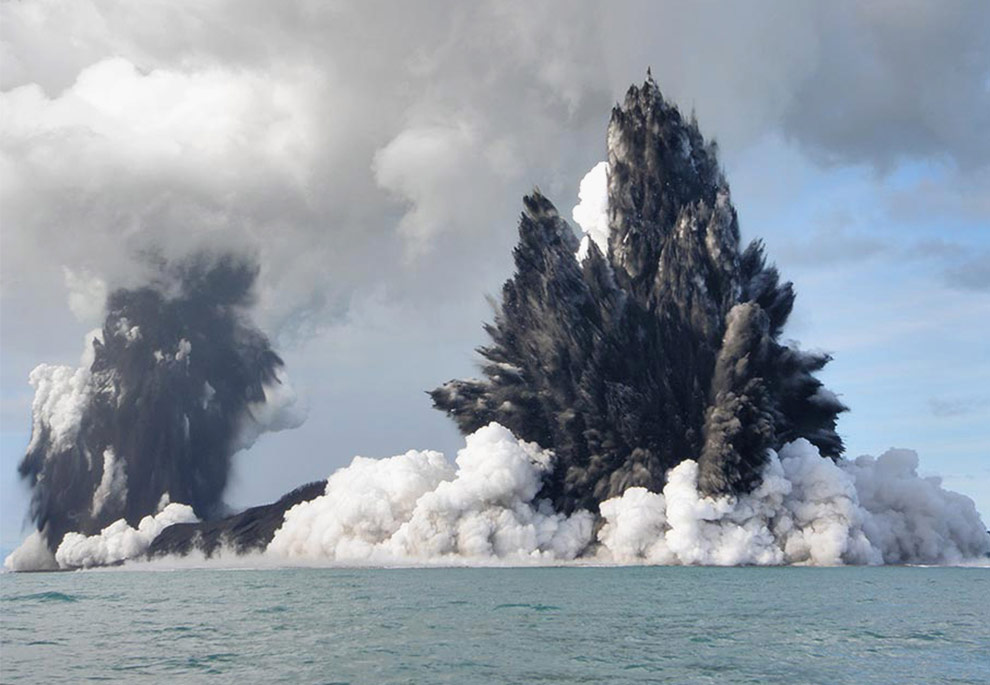
There was an undersea volcanic eruption in the western Pacific, near Tonga, this week. The Boston Globe's The Big Picture offered a set of fascinating photographs of an island being born from the eruption. The image at right is from that collection.Scrolling through these pictures brought my mind back to a series of letters written by my Grandmother in which she described a similar eruption that sprang up in the Galapagos Islands, in the eastern Pacific, off the coast of South America, in the spring of 1925.
My grandmother, Isabel Cooper, was an artist. Starting in 1917, she made seven voyages with the naturalist William Beebe to Central and South America, and surrounding equatorial seas, to study animals and plants.
This was in the days before color photography. My grandmother, as the expeditions' “scientific artist,” produced detailed color paintings of the flora and fauna of the Amazonian jungle, the Galapagos Islands, and the open ocean. The image at left is from The Arcturus adventure: an account of the New York Zoological Society's first oceanographic expedition (1926, Putnum). It shows my grandmother at work on the Arcturus, painting a live fish.During the 1925 voyage, she wrote a series of letters to my grandfather, Charles Mahaffie, who she had met the previous winter and with whom she would carry on a nearly three and a half year courtship – mostly by letter. We are lucky to have these letters in a collection edited by my father.
On Easter Sunday (April 12) of 1925, she wrote from the Arcturus:
I have put in some peculiar Easters: fire at sea five years ago; shooting rapids of the Mazaruni River last year; etc. But this time is the prize. What do you suppose has gone and happened out here in this “ash heap of the world?” Blooming volcano has broken loose, erupting all over the place. Rather decent of it to pick just this time to do it, as we are probably the only people anywhere around for a few hundred miles to observe it.They had been anchored in Darwin Bay, at Tower Island (now Isla Genovesa), when “the night watch noticed a faint glow in the direction of Albemarle Island [Isla Isabela], about sixty miles away.” When morning came they began a voyage of a day and night, across the span of the Galapagos Islands, to reach the volcano.
We got to the scene of the eruption early this morning, after the wildest possible night. You couldn't sleep. It was too exciting, steaming slowly toward the first active volcano that any of us had seen.They watched the eruption from off-shore. I think it differed from this week's eruption in that it was on an existing island and featured less explosive activity, but perhaps more lava flow. A small group went ashore and trekked close to the crater. That was probably a foolish thing to do, as she describes their return “in very bad shape.”
Legs full of cramps, from walking on hot lava, I suppose. And all symptoms of bad thirst, tongues swollen, etc. They finished their canteens in the first mile. They ran into some pretty poisonous gases, which they couldn't smell, but which made them sick.In spite of this, she had wanted to go ashore, if only at the edge of the island, but was not allowed. And she wanted to try to capture what she was seeing:
I tried to make a sketch of the thing: memory sketch of the red clouds and generally hellish aspect at night, as well as the really beautiful colors of the craters by daylight, but have arrived at the conclusion that it can't be painted. Usually takes a good whang on the head to convince me that I can't accomplish something that appeals to me to do, but this time I give up.They watched the volcano through Easter night and into the following Monday morning before returning to their work. At midnight she wrote:
We have spent the whole evening looking at the crater – flames popping up here and there and most incredible clouds rising out of it and turning all kinds of red. The moon is just about two days past the full, but enormously bright, and adds to the general strange effect.It's a large world we live on. We in the internet age are used to seeing images instantly from around the globe. We have become used to what in earlier generations would have been strange, fascinating, and special.
My grandmother's time was modern, of course; the voyages of the Arcturus were transmitted by radio (The “wireless”) and reported in the newspapers in New York. But these were just the “when” and “where” details and brief descriptions. The bright colors and fantastic shapes of alien plants, animals and fish needed the work of artists to be brought back to the home-bound public.
So as we page through yet another collection of photos from the other side of the world, or watch a YouTube video from some far frontier, we should try to remember that, at one time, even the other end of our nation was an expedition away.
What we see as “a small world, after all” is really a vast place deserving of respect and wonder. We should not let the ease of access we have inherited blind us to the size and diversity of our planet.
Saturday, April 19, 2008
Purple Prose Enlivens a Tale of the Emerald Diamond
I've been checking through old newspapers at the Library of Congress' Chronicling America site. I'm searching for references to my various forebears; it is a low-return fishing expedition, but great fun.
For example, a search for references to any Mahaffies in California in newspapers from around the turn of the 20th Century has turned up several sports-page notes about a baseball umpire named Mahaffy. I doubt that he is a direct relative, though he may be a very distant cousin. What's great about this, though, is the prose in which I find him.
Here are two paragraphs from Page 42 of the September 30, 1906, edition of the San Francisco Call. William J. Slattery writes about a game between the Portland Beavers and the San Francisco Seals (in first and second in the standings at the time).
For example, a search for references to any Mahaffies in California in newspapers from around the turn of the 20th Century has turned up several sports-page notes about a baseball umpire named Mahaffy. I doubt that he is a direct relative, though he may be a very distant cousin. What's great about this, though, is the prose in which I find him.
Here are two paragraphs from Page 42 of the September 30, 1906, edition of the San Francisco Call. William J. Slattery writes about a game between the Portland Beavers and the San Francisco Seals (in first and second in the standings at the time).
Neither team played anything that looked like high art. Errors happened frequently and did a deal of damage. Neither pitcher was there any too strong and and both of them delayed the game as much as possible by indulging in a series of senseless winding ups and warming ups between the rounds.The Seals were not doing well in their season series with the Beavers in 1906. The Beavers won this game, 3 to 1, moving to a record of 98-47 and a won/lost percentage of .697. The cellar-dwelling Fresno team, by contrast, was at .335 percent at 51-101.
Maybe it was because of the banishment of Cousin Park Wilson that San Francisco did not perform according to the tips of the wise brigade. Cousin Park assayed to engage in an oratorial contest with Umpire Mahaffy in the eighth spasm and before he realized that the worst was yet to come, the indicator man had already made a mysterious high sign and given Park notice to skidoo. He also informed the leader of the Seals that his pay envelope will be shy five dollars when the next day of reckoning with Cal Ewing is at hand.
Sunday, January 6, 2008
Field Trip Needed: Mahaffey, PA
I need to make a visit to the Borough of Mahaffey, in western Pennsylvania, somewhat southeast of Punxsutawny. I'm adding it to my list of places to visit to learn more about family history.
View Larger Map
Mahaffey is the only populated place in the US that I know of that is named for a relative of mine. There is a small lake named Mahaffie created by the US Farm Service out in Oklahoma.
I had been aware for some time that there is a place called Mahaffey in Pennsylvania, but it is only recently that my genealogical wanderings led me to a reference to the person it was named for, Robert Mahaffey, who was the grandson of my great-great-great-great-grandfather's brother. That makes him my second cousin, four times removed. It's probably more useful to say he was second cousin to my great-grandfather, Doc Mahaffie.
Back around 1750, a group of Mahaffeys emigrated from Ireland to Pennsylvania, settling originally in Cumberland County. There were either two sets of two brothers who were cousins, or more likely there were four brothers. Records are sketchy; our best source is a family history from the early 20th century.
In any case, one of those original American Mahaffeys was Charles, whose son Andrew changed his name's spelling to Mahaffie and produced JB, who produced Doc, whose son Charles was my grandfather. The elder Charles Mahaffey's brother Thomas, meanwhile, fathered William, who fathered Robert Mahaffey, who appears to have founded the settlement that now bears his name.
I had already shown Robert Mahaffie (1815 - 1900) in my family tree, but it wasn't until I found an extract from Twentieth Century History of Clearfield County, Pennsylvania, and Representative Citizens, by Roland D. Swoope, Jr. (published by Richmond-Arnold Publishing of Chicago in 1911), that I had a reference to a founder of Mahaffie:
The 2000 US Census found 402 residents; all of them white with a median age of between 39 and 40 years. According to the Bell Township/Mahaffey Borough Joint Comprehensive Plan (found via the PA County Planning e-Library) prepared in 2000, population at Mahaffey reached a peak of 801 in 1920. A lack of economic opportunities, likely tied to the shift away from an agrarian economy in the eastern US, led to high levels of out-migration.
But Mahaffey looks like an interesting place. It sits among the hills and along a mid-sized stream. There are some recreation areas nearby and a Mahaffey Camp, "A Christian Center for Spiritual Growth," up the road.
I think I may need to take a field trip to see the place for myself.
View Larger Map
Mahaffey is the only populated place in the US that I know of that is named for a relative of mine. There is a small lake named Mahaffie created by the US Farm Service out in Oklahoma.
I had been aware for some time that there is a place called Mahaffey in Pennsylvania, but it is only recently that my genealogical wanderings led me to a reference to the person it was named for, Robert Mahaffey, who was the grandson of my great-great-great-great-grandfather's brother. That makes him my second cousin, four times removed. It's probably more useful to say he was second cousin to my great-grandfather, Doc Mahaffie.
Back around 1750, a group of Mahaffeys emigrated from Ireland to Pennsylvania, settling originally in Cumberland County. There were either two sets of two brothers who were cousins, or more likely there were four brothers. Records are sketchy; our best source is a family history from the early 20th century.
In any case, one of those original American Mahaffeys was Charles, whose son Andrew changed his name's spelling to Mahaffie and produced JB, who produced Doc, whose son Charles was my grandfather. The elder Charles Mahaffey's brother Thomas, meanwhile, fathered William, who fathered Robert Mahaffey, who appears to have founded the settlement that now bears his name.
I had already shown Robert Mahaffie (1815 - 1900) in my family tree, but it wasn't until I found an extract from Twentieth Century History of Clearfield County, Pennsylvania, and Representative Citizens, by Roland D. Swoope, Jr. (published by Richmond-Arnold Publishing of Chicago in 1911), that I had a reference to a founder of Mahaffie:
Robert Mahaffey equaled his father in enterprise. He engaged also in lumbering and later cleared up a large farm in Bell township and also conducted a general store and in addition, operated a mill. His various enterprises prospered and each one assisted in the developing of the other and ere long many settlers had been attracted to his neighborhood, a village resulted and in his honor was named for the man of energy and progress, who had had the foresight to select this certain section of the wilderness as his place of investment.Today Mahaffey is something of an also-ran among the many municipalities and boroughs of Pennsylvania. I couldn't find a town government in my Google-searching. The Commonwealth of Pennsylvania doesn't link to one. And I couldn't find anything via the Pennsylvania League of Cities and Municipalities or the Pennsylvania State Association of Boroughs.
The 2000 US Census found 402 residents; all of them white with a median age of between 39 and 40 years. According to the Bell Township/Mahaffey Borough Joint Comprehensive Plan (found via the PA County Planning e-Library) prepared in 2000, population at Mahaffey reached a peak of 801 in 1920. A lack of economic opportunities, likely tied to the shift away from an agrarian economy in the eastern US, led to high levels of out-migration.
But Mahaffey looks like an interesting place. It sits among the hills and along a mid-sized stream. There are some recreation areas nearby and a Mahaffey Camp, "A Christian Center for Spiritual Growth," up the road.
I think I may need to take a field trip to see the place for myself.
Saturday, October 27, 2007
Finally, A Place to Put My Stuff
It looks like there's about 12,000 square feet of space available right now. Other tenants are Pump It Up ("The Inflatable Party Zone") and Center Point Community Church. I need to think of some business to place there; something related to history or to mapping?
As I have mentioned here before (endlessly), two of my great-great Grandparents, JB and Lucinda Mahaffie, were among the first settlers at Olathe. They established a prosperous farm that included a hostel, of sorts, as a way-station on the Oregon Trail. Several of their children stayed in Olathe and had businesses. The family name has stuck there, adhering to streets and buildings.
Of course, at the center of my family history in Olathe is the old Mahaffie House, now an historic site and park.
Aside from the Mahaffie Warehouse, you'll find the Mahaffie Retail Center on Mahaffie Circle. It has a Quizno's and everything. Elsewhere in town, there is Mahaffie Elementary School (home of the Knights) and the Woods of Mahaffie subdivision (the web site seems to be down).
I found an interesting (to me) coincidence as I researched this post. The headquarters of Garmin International is in Olathe. It's mailing address is on 151st Street, but I note that both Mahaffie Circle and Mahaffie Place run through the Garmin Campus.
Here's the coincidence: Garmin makes GPS tools and is a part of the geospatial industry. A major part of my professional life is coordinating the use and sharing of GIS tools and geospatial data. It's not a major, earth-shaking sort of coincidence, but it does suggest to me that I should seek out the Garmin booth at the next GIS conference and say "howdy."
Tuesday, June 12, 2007
Why Don't We Write This Way Anymore?
I'm still rooting around in the past, looking for ancestors. This evening I have been reading through portions of William G. Cutler's History of the State of Kansas, published in 1883. He gives an early history of the town of Olathe, where parts of my family settled and prospered generations back.
I love the way Cutler describes events from what was, for him, only a few decades ago. For example, in his section on early inhabitants of Olathe, he has this to say about one gent:
John P. Campbell, a cousin of James K. Polk, came here from Nashville, Tenn. He was looked upon as a brilliant and promising lawyer in the State, but he impaired his faculties by the use of alcoholic stimulants, and died of consumption in the early years of the war.Later, in his section on newspapers in Olathe, he recounts the effect of an attack by Quantrill's raiders on the town's only Democrat newspaper at the time, the Olathe Herald, which had been a growing and healthy concern:
Quantrill paid the office a visit September 6, 1862, after which John M. Giffin, its editor and proprietor, gathered up its debris and sold it for $306; original cost having been $3,500. In addition to his newspaper office, Mr. Giffen also lost through Quantrill's efforts, accounts and notes to the amount of $13,000, and the manuscript of an algebra, for which he had been offered $5,000, and fifteen cents royalty on each book sold.My favorite, though, is his description of the "Reformed Presbyterian, or Covenanter Church." A congregation formed in Olathe in 1865, and split into two in 1871:
This denomination wherever founded is radical in its character, forward in reform movements, and never received into, nor tolerated slaveholders in its communion. While its members have borne arms in every national conflict for right and liberty, yet they refrain from the exercise of the elective franchise--believing the National constitution to be, though in many respects most excellent, yet in some things infidel and immoral.Seems like I've read similar sentiments on modern day blogs as well.
Monday, June 11, 2007
Where I'm From
I've been spending a lot of time lately looking into my genealogy, playing around on a site called Geni which is an on-line family-tree tool. I've looked into family past before, of course, but now that I've started working on the family tree I've found a great deal of material on-line.
As part of this, I've put together a map of the birth-places of my direct ancestors; at least those whose birthplaces I could determine.
The earliest Mahaffies I could find -- they were Mahaffeys back in the 1700s-- were from northern Ireland. There were Beckers, from my Mother's side of the family, born in Germany in the 1800s.
In the US, there was a steady progression west by my branch of the Mahaffie family. They were in Pennsylvania, then Ohio, then Indiana. My Great-Great Grandfather JB Mahaffie started his family in Indiana and then settled in Olathe Kansas in 1857. He was one of the original settlers.
My Great Grandfather George Mahaffie had been born in Indiana. He started his family in Olathe, where my grandfather Charles was born. George took his family west to Oklahoma as homesteaders.
My grandfather was a Rhodes Scholar, studying at Oxford for a time. He became a lawyer and lived and practiced in Oregon before going to Washington DC, where my Father was born. My Grandmother had been born in Washington State, but raised in New York City, where many of her forbears were born.
On my Mother's side, Farrars, Beckers, Bartletts, and Redmonds were mostly around New York. I also had forbears in upstate New York and in Vermont.
If any of these names and dates match names and dates in your family tree (and you are not already part of my family tree), let me know. I'm always eager to expand the tree.
As part of this, I've put together a map of the birth-places of my direct ancestors; at least those whose birthplaces I could determine.The earliest Mahaffies I could find -- they were Mahaffeys back in the 1700s-- were from northern Ireland. There were Beckers, from my Mother's side of the family, born in Germany in the 1800s.
In the US, there was a steady progression west by my branch of the Mahaffie family. They were in Pennsylvania, then Ohio, then Indiana. My Great-Great Grandfather JB Mahaffie started his family in Indiana and then settled in Olathe Kansas in 1857. He was one of the original settlers.
My Great Grandfather George Mahaffie had been born in Indiana. He started his family in Olathe, where my grandfather Charles was born. George took his family west to Oklahoma as homesteaders.
My grandfather was a Rhodes Scholar, studying at Oxford for a time. He became a lawyer and lived and practiced in Oregon before going to Washington DC, where my Father was born. My Grandmother had been born in Washington State, but raised in New York City, where many of her forbears were born.
On my Mother's side, Farrars, Beckers, Bartletts, and Redmonds were mostly around New York. I also had forbears in upstate New York and in Vermont.
If any of these names and dates match names and dates in your family tree (and you are not already part of my family tree), let me know. I'm always eager to expand the tree.
Thursday, November 11, 2004
A Look Back at Family History
I'll give some credit this evening to Microsoft and the beta version of their new MSN Search. Though it looks for all the world like an imitation of Google, it did turn up something of great interest to me when I tried the obligatory vanity search on "Mahaffie." The regular search returned the usual plethora of Mahaffie House and Stagecoach Shop hits, so I tried an Image Search on "Mahaffie."
The search returns gave top ranking to a JPEG copy of an old (and unfortunately undated, but likely from 1958) newspaper obituary of Ella Mahaffie, my great-great-aunt (I think). To be fair, this image also turned up in a Google image search, but lower down the page.
The obituary features this photo of the Mahaffie House in Olathe, Kansas, apparently taken before the house became a managed historic site.

I was already, of course, aware of the Mahaffie House and of its status as public property in Olathe. I had also heard mention in the family of "Aunt Ella". I'm not sure I'd seen this clipping, however -- at least not as an adult -- and it has been a pleasure to read through it.
Ella Mae Mahaffie was born in 1869, on the Mahaffie farm at Olathe, one of eight children of J.B. and Lucinda Mahaffie. She apparently grew to be a well-rounded woman and served as an educator all of her professional life. She taught in a "country" school in the last part of the 19th century (one-room schoolhouse?), she taught 3rd and 7th grades in the public schools and served from 1913 until her retirement in 1939 as principal of Park Elementary School, in Kansas City. She also served on the Kansas State Board of Education.
The obituary mentions no college degrees, but notes that Ella Mahaffie continued studying at various universities throughout her career and traveled extensively in the US and Canada and somewhat in Europe as well.
One of Ella's brothers left the farm and took his family, including Charles D. Mahaffie (my grandfather), to Oklahoma. Charles grew up in Oklahoma, studied there and in England and became a lawyer out west. He came to Washington DC for a government job in the early part of the 20th century and eventually gave the world a son, Charles Jr., my Dad. I'm damn glad he did too!
The clipping is part of an on-line collection, History of the Public Schools of Wyandotte County, Kansas - 160 Years Enriching the Minds of Children. There's plenty of good stuff in there, including a set of images of Park School that includes the Plot Plan of the school. Note the careful separate of the girl's and boy's out-houses.
The search returns gave top ranking to a JPEG copy of an old (and unfortunately undated, but likely from 1958) newspaper obituary of Ella Mahaffie, my great-great-aunt (I think). To be fair, this image also turned up in a Google image search, but lower down the page.
The obituary features this photo of the Mahaffie House in Olathe, Kansas, apparently taken before the house became a managed historic site.


I was already, of course, aware of the Mahaffie House and of its status as public property in Olathe. I had also heard mention in the family of "Aunt Ella". I'm not sure I'd seen this clipping, however -- at least not as an adult -- and it has been a pleasure to read through it.
Ella Mae Mahaffie was born in 1869, on the Mahaffie farm at Olathe, one of eight children of J.B. and Lucinda Mahaffie. She apparently grew to be a well-rounded woman and served as an educator all of her professional life. She taught in a "country" school in the last part of the 19th century (one-room schoolhouse?), she taught 3rd and 7th grades in the public schools and served from 1913 until her retirement in 1939 as principal of Park Elementary School, in Kansas City. She also served on the Kansas State Board of Education.
The obituary mentions no college degrees, but notes that Ella Mahaffie continued studying at various universities throughout her career and traveled extensively in the US and Canada and somewhat in Europe as well.
One of Ella's brothers left the farm and took his family, including Charles D. Mahaffie (my grandfather), to Oklahoma. Charles grew up in Oklahoma, studied there and in England and became a lawyer out west. He came to Washington DC for a government job in the early part of the 20th century and eventually gave the world a son, Charles Jr., my Dad. I'm damn glad he did too!
The clipping is part of an on-line collection, History of the Public Schools of Wyandotte County, Kansas - 160 Years Enriching the Minds of Children. There's plenty of good stuff in there, including a set of images of Park School that includes the Plot Plan of the school. Note the careful separate of the girl's and boy's out-houses.
Subscribe to:
Posts (Atom)
